
 English
 Deutsch
 Italia
 français
 Español
 Português
 русский
 العربية
 日本語

Workshop
Custom packaging is a production job before it is a design job. This page explains how a job moves through the workshop, what is checked at each stage, and what decides whether a box arrives looking the way it did on the proof. It is written for buyers who need to know where the risk sits, not for buyers who want a brochure.
Inside the Workshop
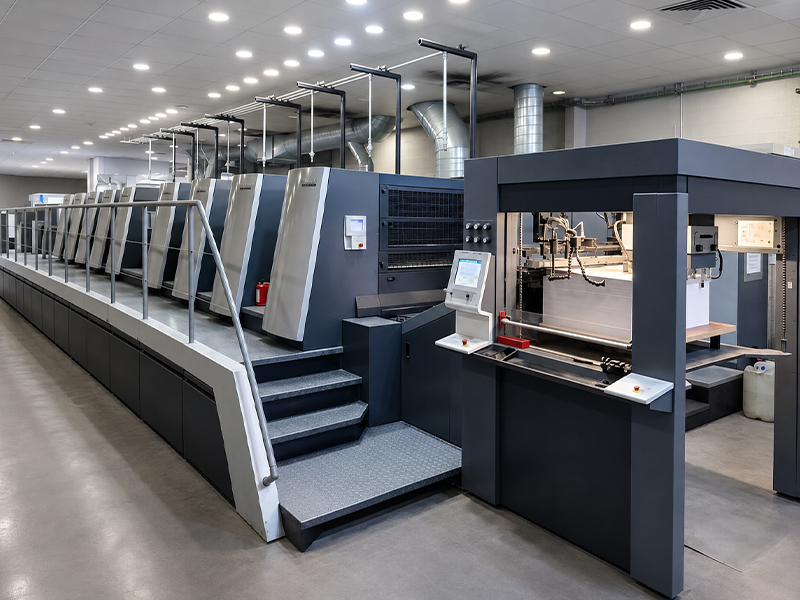
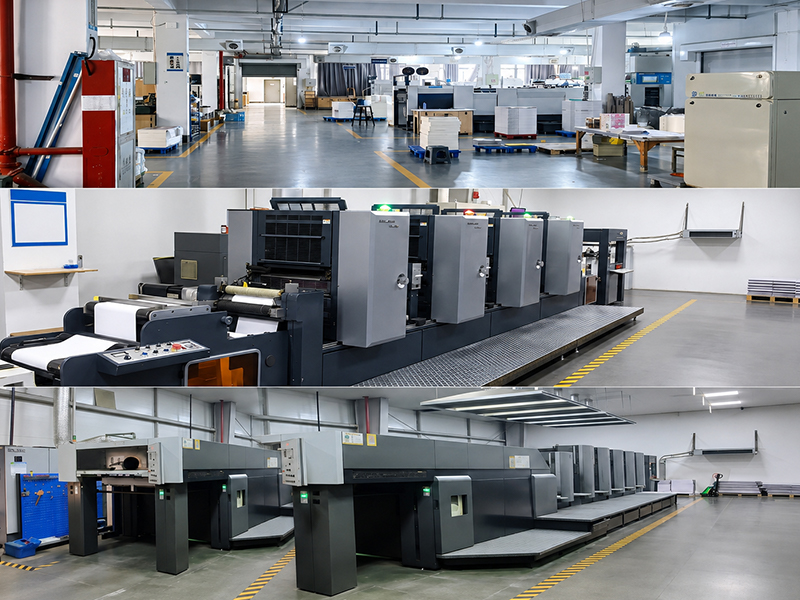
The production floor covers 101-500 square metres and runs with a team of 11-50 people, a scale built for short runs and repeat orders rather than container-volume contracts. Pre-production samples are checked in a sample test room before any mass run begins, and a dedicated team handles structure and artwork development so the dieline is settled before printing starts. Printing is offset, digital, screen and label printing. We have taken part in three trade exhibitions.


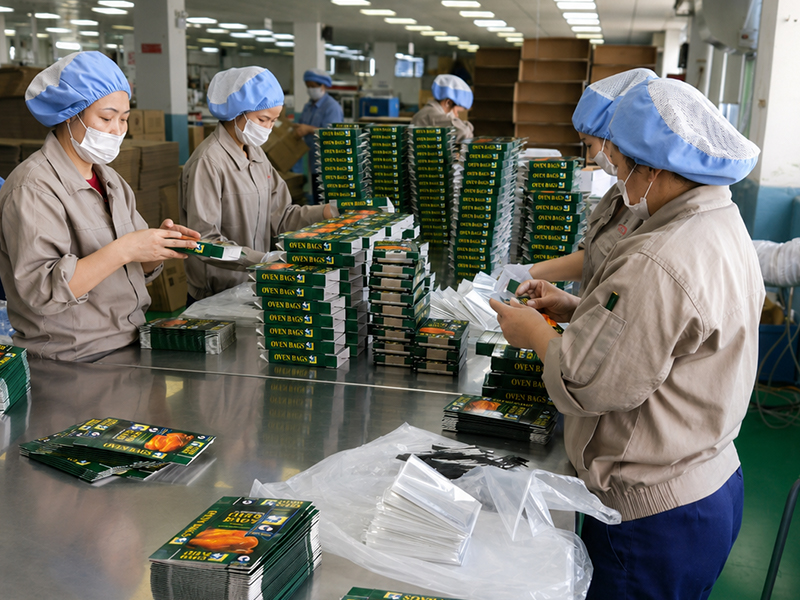
Left: label reels sorted and checked by hand on the workshop floor. Centre: printed boxes packed with inner protection before the carton is sealed. Right: cartons labelled and sealed ready for dispatch.
What the Workshop Produces
We print and convert custom paper packaging: folding cartons and rigid boxes, paper bags, cards and hang tags, self-adhesive labels, thermoformed plastic trays, and the outer packaging for vials, cartridges and pens. Work is specified by stock, print and finish rather than by a single product name, because the same box shape can be a 300gsm art paper carton or a 1,200gsm greyboard rigid box with a magnetic closure, and those two are different jobs with different tooling.
Stock, Print and Finishing
On stock we work with art paper, kraft, silver card, and synthetic paper such as PE and PET. On finishing we quote foil stamping in gold, silver, red gold and laser silver; spot UV; matte and gloss lamination; embossing; and holographic laser-silver effects. Plastic trays are thermoformed. Each combination behaves differently in production: a foil needs enough clear area around it to register cleanly, a matte laminate resists fingerprints but scuffs more on a box that is handled repeatedly, and a kraft stock shifts the colour of everything printed on it. Those are production facts, and they are cheaper to settle before tooling than after.
How a Job Moves Through Production
A job starts with the specification and the dieline. The dieline is issued first, so artwork is built on the shape that will actually be cut rather than on a rectangle that resembles it. Prepress then checks bleed, colour separation and the position of every finish against the dieline. Printing follows, then finishing, then die-cutting and gluing or mounting, then packing. Each stage hands over a physical result that the next stage can reject, which is why an error is far cheaper to catch at pre-press than at gluing.
Four Quality Control Gates
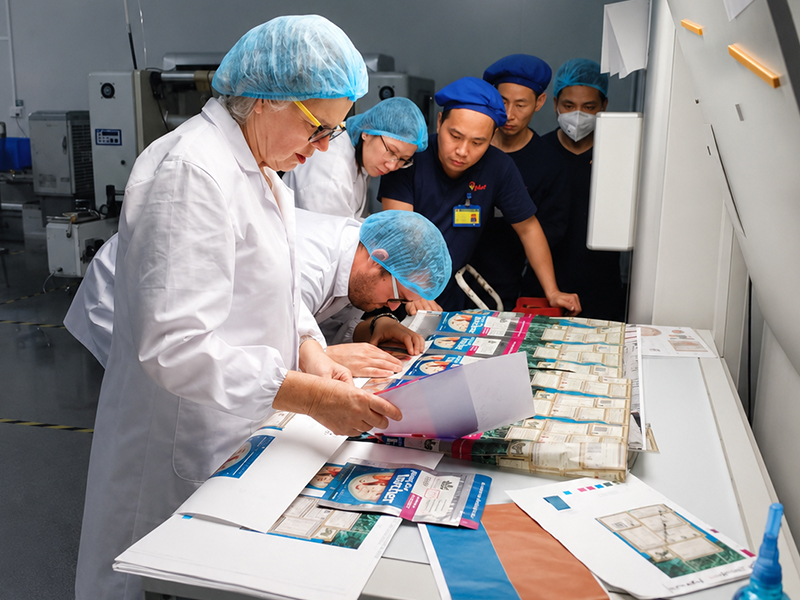
Quality is checked at four points rather than one. Incoming material is checked against the specification before production starts. The first article off the run is measured against the approved proof and sample, and the run does not continue until it matches. In-process random sampling is taken through the run, not only at the end. Final inspection follows an AQL plan, after which defective pieces are isolated and counted out of the shipment instead of being sorted later. The QC record travels with the order, which is what makes a claim checkable rather than a debate.
Sampling Before a Production Run
A physical sample takes one to three business days, made on the specified stock with the specified finishes. This is where most specification problems surface: a colour that shifts on kraft, a foil that reads too dark next to a matte laminate, a thermoformed tray that sits a fraction too tight. Sampling is not a formality before a large order; it is the cheapest point at which a specification can still be changed.
Order Sizes and Lead Times
Boxes, cards and plastic trays start at 100 pcs, paper bags at 100 pcs, labels at 1,000 pcs, and flexible packaging at 500 pcs. Design is free: one to three options in two to three working days, with two to three rounds of revision included. Sampling takes one to three business days and bulk production takes seven to fifteen business days from artwork and deposit confirmation. A quotation takes 24 hours and states the unit basis, the proofing position, the lead time and the payment terms.
What We Do Not Do
We print and convert packaging. We are not a pharmaceutical manufacturer and we do not produce, fill, sterilise or test any product. We do not hold product licences. If your project needs a specific certificate or a regulated declaration, raise it in your first message so we can tell you honestly whether it can be met before you invest time in a specification we cannot support.
workshop
workshop
workshop
workshop
LOGO
