
 English
 Deutsch
 Italia
 français
 Español
 Português
 русский
 العربية
 日本語
日本語
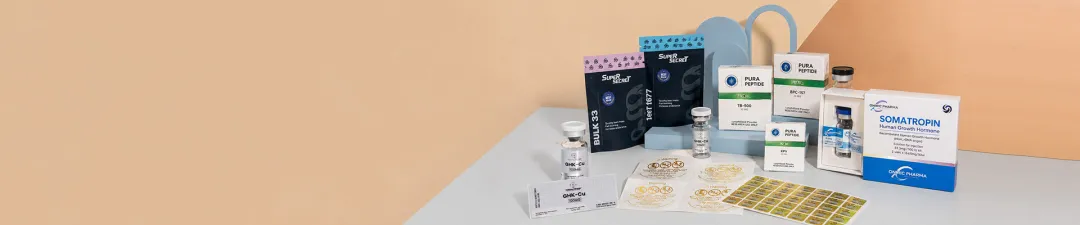

A vial glass bottle is the small glass container — usually 3ml, 5ml or 10ml — that a peptide, a research compound, a cosmetic serum or a supplement is filled into. We do not make the glass. What we do is print the outer packaging that goes around it (carton, label, tray, card) and, where a client needs everything from one place, quote matched vials, stoppers and caps alongside that packaging. Availability, format and quantity are confirmed with your quotation when you enquire. Design and proofing are free, quotes come back within 24 hours, and packaging samples take 1–3 business days. Matched vials and closures are available in 3ml, 5ml, 10ml, 25ml and 30ml.
What We Supply, and What We Do Not
This is the part worth being exact about, because the word “pharmaceutical” appears all over this category and it invites the wrong assumption.
We are a printed-packaging supplier, not a pharmaceutical manufacturer. We do not make medicine, we do not fill vials, and we do not sterilise anything. We also do not blow, mould or draw the glass itself.
What we do:
- Print and form the outer packaging — folding cartons, rigid boxes, pressure-sensitive labels, thermoformed trays and printed cards, from our operation in Wenzhou.
- Match the packaging to your actual vial — we work from your vial’s outer diameter and its height with the closure fitted, so the carton, the tray and the label agree to a fraction of a millimetre.
- Quote the glass and the closure alongside it where you want a single source. If you would rather buy the bottle, the stopper and the aluminium cap together with the packaging, tell us in the enquiry and we will confirm the formats we can supply. If you already have a vial supplier you are happy with, we will simply print the packaging to their dimensions.
Being clear about that boundary is not a limitation — it is what stops a packaging enquiry turning into a compliance conversation we cannot answer.
Matching the Packaging to the Vial You Actually Use
Most vials in this size range look alike and are not. Two 3ml vials from different suppliers can differ in neck finish, in the height the crimp adds, and in the wall thickness that changes the outer diameter by a couple of tenths. Every one of those differences moves the packaging.
So the enquiry starts with four numbers rather than with artwork:
- Outer diameter of the vial body
- Height with the closure fitted — not the glass alone
- How many vials sit in one box, and whether they travel upright
- The label’s finished height and the thickness of the applied label
From those we propose the carton’s internal dimensions, the clearance, whether a paper tray is enough or a thermoformed tray is needed, and where the label seam falls. We send a structural drawing with the quote — normally within 24 hours — so you can check the geometry before anything is printed.
The reason this matters more on vials than on most packaging is that the parts are all small. A millimetre of extra clearance that would be invisible on a shoe box is the difference between a vial that sits still and one that rattles against the cap in transit.
Labels, Trays and Cartons for Glass Vials
A vial presentation is normally three printed parts, and they should be designed as one set.
The vial label is pressure-sensitive, printed on roll or sheet and die-cut to shape, from 1,000 pcs. On a 3ml vial the curve eats a sliver of the leading edge, so text and thin rules are kept away from the wrap; the seam gap is set deliberately rather than hidden. Stock choice follows the handling condition: coated paper by default, synthetic paper, milky white PE or clear film where the vial is chilled, wiped down or stored damp.
The tray is either folded from the same board as the carton or thermoformed in plastic, from 100 pcs. A paper tray is the lighter and cheaper option and holds a single vial upright; a thermoformed tray is chosen when the vial must not move at all, or when several travel together. Each cavity is shaped to the vial rather than to a generic size.
The carton is built from the vial dimensions outward, printed on coated paper, kraft, silver card or synthetic stock, and finished with hot foil stamping, UV spot coating, matte or gloss lamination, or embossing. Because the carton, the tray and the label are proofed together, the colour you approve on the label is the colour we match on the box.
Quantities, and Why They Differ by Part
Boxes, cards and trays start at 100 pcs. Labels start at 1,000 pcs. The gap is a production fact rather than a sales policy: label printing and die-cutting are set up on a roll, so a 1,000-piece run is what makes the setup worth doing, while a carton can be produced economically at 100.
That combination suits a first order well. You can take 100 cartons and 100 trays, and 1,000 labels to cover the same batch and the next few, prove the fit on a physical sample in 1–3 business days, and only then commit to a larger run. Artwork and dies stay on file, so a repeat run changes the price per unit and nothing else.
If your order includes matched vials, stoppers or caps, those quantities are quoted separately — they follow their own packing units, which is exactly why we confirm availability and format at quotation rather than listing a number here.
How an Order Runs
- Send the vial data and the quantity — outer diameter, height with closure, vials per box, and the packaging quantity.
- Structural drawing and quote within 24 hours, including the tray recommendation and, if you asked for them, matched vials and closures.
- Free design and proofing. Send artwork and we place it on the dieline and return a proof. If you have only a logo, we propose one to three directions — normally within two to three days — and revise them until the proof is right.
- Physical sample in 1–3 business days. You check it against the real vial while a millimetre error is still cheap to fix.
- Bulk production in 7–15 business days after approval, behind four quality gates: incoming material, first article, in-process random sampling, and final AQL inspection with any defect isolated rather than shipped.
- Delivery by sea, air or express to the regions we serve. Payment is T/T with a 30–50% deposit.
FAQ
Do you manufacture the glass vials?
No. We print and form the outer packaging — carton, label, tray and card. Where a client wants the vials, stoppers and caps supplied alongside the packaging, we can quote them as matched items and confirm the formats available when you enquire.
What is the minimum order?
Packaging: 100 pcs for boxes, cards and trays, 1,000 pcs for labels. Matched vials and closures are quoted separately because they follow their own packing units.
What do you need from me to quote?
The vial’s outer diameter, its height with the closure fitted, how many vials go in one box, and the packaging quantity. Artwork helps but is not needed to start.
Can you match the packaging to vials I already buy elsewhere?
Yes, and that is the more common case. Send the dimensions of the vial you use and we will build the carton, the tray and the label to it rather than to a catalogue size.
Which label stock suits a chilled or handled vial?
Start with synthetic paper or milky white PE rather than uncoated paper, and tell us the storage conditions so the adhesive is specified for them as well as the face stock.
How fast can I see something?
Structural drawing and quote within 24 hours; design proposals in about two to three days; a physical sample in 1–3 business days.
Do you claim any certification?
No. We are a printed-packaging supplier, not a pharmaceutical manufacturer, and we do not publish certification claims. If your project needs specific documentation, mention it in the enquiry and we will confirm what we can actually provide.
Start a vial packaging project — send your vial’s outer diameter, its height with the closure, and the quantity you need, and you will have a structural drawing and a price within 24 hours. Free design and free proofing; packaging from 100 pcs (labels from 1,000 pcs); samples in 1–3 business days. If you want the vials and closures supplied with the packaging, ask in the enquiry and we will confirm what is available.
