
 English
 Deutsch
 Italia
 français
 Español
 Português
 русский
 العربية
 日本語
日本語
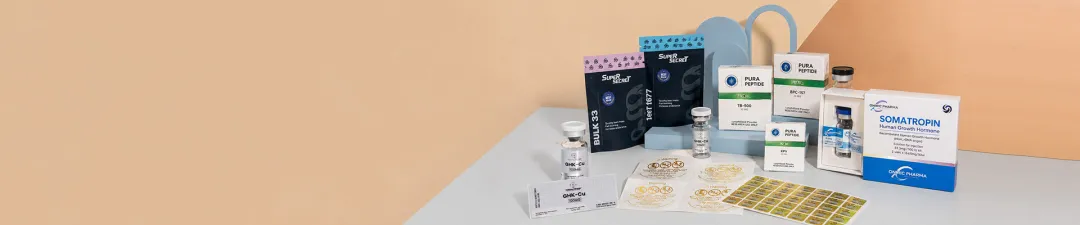

A hologram sticker is a pressure-sensitive label made from holographic or laser silver film, used as a visual brand seal on packaging, cartons, vials and closures. We print hologram stickers at our Wenzhou factory from 1,000 pcs, with free design and free proofing; quotes come back within 24 hours, physical samples in 1–3 business days and bulk in 7–15 business days. If you want a holographic label that is matched to your box, your vial label or your tamper strip, we can produce the whole set together so the finish reads consistently.
What Makes a Holographic Label Different
A holographic label is not simply a shiny sticker. The film carries a fine embossed pattern that refracts light, and that pattern is the reason the label reads as a security or premium signal rather than as decoration.
There are two common routes. The first is to print onto holographic stock: the film supplies the background pattern, and your artwork is printed over it. The second is to print on a metallic or clear film and then apply a registered holographic element, which allows the hologram to appear only where you want it rather than across the whole label.
Both routes are a printing job, not a chemistry job. We print on holographic and laser silver stock and can combine it with hot foil stamping and UV spot coating. What we cannot do is describe any printed element as counterfeit-proof — no printed label is. A holographic label makes copying harder and makes a genuine product easier to recognise; how much protection you need is a brand decision that we print to, not one we certify.
A practical note on design: holographic film is busy. Fine type laid directly over the pattern becomes hard to read, so text is usually reversed out or placed on a solid printed panel, and the hologram is left as a border, a seal or a logo field.
Holographic Vial Sticker and Small-Format Applications
Small vials and closures are where holographic film earns its keep, because a small surface has no room to explain itself.
A holographic vial sticker is normally a small die-cut label applied over the cap, along the seam, or beside the vial label. Its job is to signal that the vial has not been opened and to add an obvious brand marker that a plain paper label cannot provide on a 3 ml surface.
Applying film to a curved cap is more demanding than applying it to a flat panel. The label has to conform to the curve without lifting, and the hologram has to sit on the part of the curve that catches light rather than on the part that faces the shelf. We ask for the cap’s outer diameter and the placement height, and we cut the piece to follow the curve rather than assuming a flat circle will lie down.
The same construction is used on pen closures, small tubes and dropper bottles. On any of these, the trick is to keep the hologram small and placed deliberately, because a large holographic field on a small round object reads as glare rather than as design.
Laser Silver, Rainbow and Registered Holograms
The words buyers use for holographic stock vary, and the differences matter when you are specifying.
Laser silver is the most common holographic film. It has a fine, regular grain and a strong silver-white base, and it is the stock most laser silver label projects are describing. It prints well and takes a printed panel cleanly.
Rainbow or diffraction film shifts colour as the viewing angle changes, so the label moves from silver to green, blue or pink. It is chosen for a stronger visual effect, often on cosmetic and gift packaging where the label is meant to be noticed.
Registered holograms place a specific image — a logo, a wordmark or a patterned seal — in a defined position on the label rather than covering the whole face. This is the format used when a brand wants a recognisable security seal rather than a full holographic background.
Partial or striped holographic film applies the effect in bands so that part of the label is holographic and part is plain, which lets a single piece carry both a metallic seal and readable type.
We will send film swatches with a physical sample so you can compare the effect under real light before committing to a run. Holographic film looks different in a warehouse, on a shelf and on a phone screen, and it is worth checking all three.
Foil, Holographic Film or Both
A brand often asks whether holographic film is better than hot foil stamping, and the honest answer is that they do different jobs.
Hot foil stamping, in gold, silver, red gold or laser silver, applies metal to a chosen area of an otherwise ordinary label. It is crisp, precise and controlled, and it lets the rest of the label stay matte and readable. If only the logo needs to be metallic, foil is usually the cheaper and cleaner option.
Holographic film changes the whole background of the label. It is the right choice when the label itself should read as a security or premium seal, or when the product needs to be recognisable at a glance across a shelf.
Both together is common on a box or a larger carton: a holographic or laser silver panel as a seal field, plus a hot foil logo elsewhere for crispness. On small vials, using both at once usually crowds the surface, and one effect placed deliberately works better than two competing.
Tell us where the label sits and what it has to communicate, and we will recommend one route rather than selling both. If the answer is that a simple foil logo is enough, that is what we will tell you.
Quantities and How a Hologram Sticker Order Runs
Labels start at 1,000 pcs, and boxes, cards and plastic trays start at 100 pcs. Printing and die-cutting are set up on a roll, so a 1,000-piece first run is what makes the setup worthwhile; a box can be produced economically at 100.
The sequence for a first order:
- Send the artwork, the surface the label goes on, and the quantity. For a cap or a vial, send the outer diameter and the placement height.
- We return a dieline and a quote within 24 hours, including a film recommendation and the effect you can expect.
- Free design. Send artwork and we place it on the dieline and return a proof. If you have only a logo, we propose one to three layouts, normally within two to three days, and revise until it is right.
- Physical sample in 1–3 business days, with film swatches so you can compare the effect in real light.
- Bulk production in 7–15 business days after approval, behind four quality gates: incoming material, first article, in-process random sampling and final AQL inspection with defects isolated.
- Delivery by sea, air or express to the regions we serve. Payment is by T/T with a 30–50% deposit.
FAQ
What is the difference between a hologram sticker and a holographic label?
There is no difference in construction — both are pressure-sensitive labels made from holographic film. “Sticker” usually describes a small die-cut piece such as a seal, while “label” often describes a larger piece wrapped onto a product or a carton.
Can you make a holographic vial sticker for a 3 ml vial?
Yes. Small die-cut pieces for caps, seams and vial bodies are a standard request. Send the cap or vial’s outer diameter and the placement height, and we will return a dieline.
Is laser silver the same as holographic?
Laser silver is one holographic film, the fine-grain silver stock that most buyers mean when they say holographic. Rainbow and other diffraction films shift colour with the viewing angle, and registered holograms place a specific image rather than covering the whole label.
Can you combine hot foil with holographic film?
Yes. Foil is often used for a crisp logo while holographic film supplies a seal field. On very small labels we usually recommend choosing one effect rather than both.
Does a hologram sticker make my product counterfeit-proof?
No printed label is counterfeit-proof, and we will not describe one as such. A holographic label makes copying harder and a genuine product easier to recognise; how much protection you build is a brand decision.
What do you need from me to quote?
The artwork or the logo, the surface the label is applied to, the finished size, and the quantity. Artwork is helpful but not required to start.
Start a hologram sticker project — send your artwork, the surface it goes on and your target quantity, and you will have a dieline and a price within 24 hours. Free design and free proofing; labels from 1,000 pcs; samples in 1–3 business days.
