
 English
 Deutsch
 Italia
 français
 Español
 Português
 русский
 العربية
 日本語
日本語
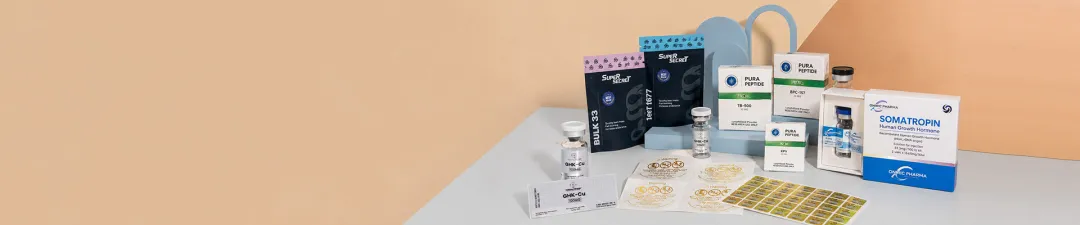

A pharmaceutical packaging box is the printed outer carton that surrounds a medicine, supplement or research product — a folding carton, a printed sleeve or a rigid box that carries the brand, the dosage line and the handling information. We print that outer packaging at our Wenzhou factory from 100 pcs, with free design and free proofing, quotes back within 24 hours, samples in 1–3 business days and bulk in 7–15 business days. One point of our scope matters before anything else: we are a packaging supplier, not a pharmaceutical manufacturer. We print the box around the product; we do not make, fill, test or sterilise it.
What a Pharmaceutical Packaging Box Has To Do
A carton in this category is judged on function first. It has to survive distribution, hold its shape on a shelf or in a fulfilment bag, and present information without ambiguity.
The first job is protection. A 3ml vial, a blister strip or a cartridge is small and fragile, and the box stops it moving. That is a geometry problem before it is a printing problem: we ask for the container’s outer diameter, its height with the cap, and how many units go in one carton, then set the internal dimensions and clearance from those numbers rather than from a catalogue size.
The second job is legibility. On a small panel the type is small and is read at arm’s length or photographed for a listing. We keep text away from the score line, avoid thin rules that break up at press, and reserve the flat front panel for the elements a buyer looks for first.
The third job is integrity. A box that pops its tuck flap in a depot or scuffs its finish against a master carton looks careless, so board grade, base construction and lamination are chosen for how the box travels.
Why the outer box, and not the product itself
Because our scope is the printed packaging, we are deliberately not part of the product side of the supply chain. The carton, the sleeve, the tray and the label are ours; the medicine, the filling and the release of the product are not. A client who needs a compliant product still owns that part of the job; our role is to make the packaging they specify, to their artwork.
Pharma Outer Packaging: Where Primary, Secondary and Tertiary Fit
Pharma outer packaging is the printed material outside the immediate container, and it helps to be precise about which layer you are buying.
The primary layer is the container and closure that touches the product — the vial, the stopper, the crimp cap, the blister. The secondary layer is the printed material around it: the carton, the label, the tray, and the seal or tamper strip that closes the box. The tertiary layer is the shipper that carries the finished packs.
Secondary packaging is the layer we print
Everything in the secondary group — the folding carton, the pressure-sensitive label, the thermoformed tray, the printed card — is what we produce. That is where we add value, because the carton, the tray and the label have to agree to a fraction of a millimetre and match in colour, and that is easier to guarantee when one plant proofs all of them together.
What we do not do, stated plainly
We do not manufacture medicines, we do not hold a pharmaceutical licence, and we do not describe our output as pharmaceutical-grade. If a procurement process requires a qualified product manufacturer, we are not that supplier. We are the printer who makes the box, label and tray around the product.
Medicine Box Printing: Stock, Finish and Readability at Small Size
Medicine box printing lives or dies on restraint, because the panel is small and the reader is often in a hurry.
Stocks we print on
We print on coated paper, kraft, silver card and synthetic stock, plus PET for thermoformed trays and PE or synthetic paper for labels. Coated paper is the default for a carton because it takes fine type cleanly; kraft suits an uncoated look; silver card gives a metallic base; synthetic stock and PE survive moisture or a wipe-down.
Finishes that suit a medicine carton
Hot foil stamping in gold, silver, red gold or laser silver gives a small carton weight without shouting. UV spot coating lifts one element — a molecule name or a dosage badge — against a matte background and is the cheapest way to create contrast. Matte or gloss lamination protects the print during handling, and matte is the more common choice for a clinical look. Embossing raises the logo as texture. We also print on holographic and laser silver stock for an overt anti-counterfeiting look, though we will not describe any printed element as counterfeit-proof.
Readability rules for a small panel
Keep the leading information inside the flat area of the panel; a 3mm margin either side is usually enough. Avoid hairline rules under 0.3 pt, which fill in at press. Use one metallic accent at most, because a small panel that carries three finishes reads as noise.
Structures: Cartons, Sleeves, Trays and Multi-Vial Boxes
There is no single best structure — there is the structure that suits the product, the quantity and the journey.
Folding cartons and printed sleeves
A folding carton is printed flat and shipped knocked down, which keeps freight down and makes it the default for a range with several SKUs. A printed sleeve wraps an existing plain container and brands a product without building a new carton. Both are produced from 100 pcs.
Paper trays, thermoformed trays and multi-vial boxes
Inside the carton, a paper tray is the lightest option and holds a vial upright so the cap never touches the lid. A thermoformed plastic tray is chosen when the container must not move at all, or when several sit in one box; each cavity is shaped to the vial. A multi-vial storage box with a divider is built for handling and shipping rather than shelf display. Boxes, cards and trays all start at 100 pcs.
Cards, seals and paper bags that complete the pack
Header cards, printed cards and tamper strip seals close the set when a product ships with an accessory or in a bag. Because we also print paper bags, a clinic or pharmacy pack can be completed from the same artwork and proof.
Low MOQ, Free Design and How the Order Runs
Boxes, cards and plastic trays start at 100 pcs; labels start at 1,000 pcs. For a first order that threshold is usually the difference between launching and waiting.
What 100 pcs changes
A first run of 100 lets you fill, photograph and ship a real pack, see how the vial behaves in the carton, and find out whether your dimensions were right — without a ten-thousand-piece commitment based on a digital mock-up. A 100-piece run spreads setup cost over fewer units, so the unit price is higher than at 5,000; we quote both so the trade-off is visible. And 100 pcs is a production minimum, not a sample quantity.
The process, step by step
Send the container dimensions, how many units per box and the quantity. You get a structural drawing and a quote within 24 hours, including a tray recommendation and any dimension that should change. Design is free: send artwork and we place it on the dieline and return a proof, or if you have only a logo we propose one to three directions, normally within two to three days, and revise until it is right. A physical sample follows in 1–3 business days and bulk in 7–15 business days, behind four quality gates: incoming material, first article, in-process random sampling, and final AQL inspection with defects isolated. Delivery is by sea, air or express to the regions we serve; payment is T/T with a 30–50% deposit.
FAQ
What is the minimum order for a pharmaceutical packaging box?
Boxes, cards and plastic trays start at 100 pcs; labels at 1,000 pcs. Samples are separate and take 1–3 business days.
What does “pharma outer packaging” cover if you are not a manufacturer?
It covers the printed material outside the container: the carton, the label, the paper or thermoformed tray, printed cards and the seal that closes the box. It does not cover the product or the filling.
Can you handle medicine box printing as well as the structural design?
Yes. One artwork approval covers the print, the dieline and the tray, so the carton, the label and the tray come from one supplier and match in colour and dimension.
Is secondary packaging something you produce, or only the carton?
We produce the whole secondary layer — carton, label, tray and cards — so the fit between the container, the tray and the box is settled in one design step.
Do you describe your output as pharmaceutical-grade or certified?
No. We are a printed-packaging supplier, not a pharmaceutical manufacturer, and we do not claim certifications. We print to the artwork and specification you supply.
How do I start a pharmaceutical packaging box project?
Send the container’s outer diameter and height, how many units fit per box, and the quantity. You will have a structural drawing and a price within 24 hours, with free design and proofing included.
Start a pharmaceutical outer packaging project — send your container dimensions and target quantity, and you will have a structural drawing and a price within 24 hours. Free design and free proofing; boxes and trays from 100 pcs; samples in 1–3 business days.
