
 English
 Deutsch
 Italia
 français
 Español
 Português
 русский
 العربية
 日本語


How we control quality
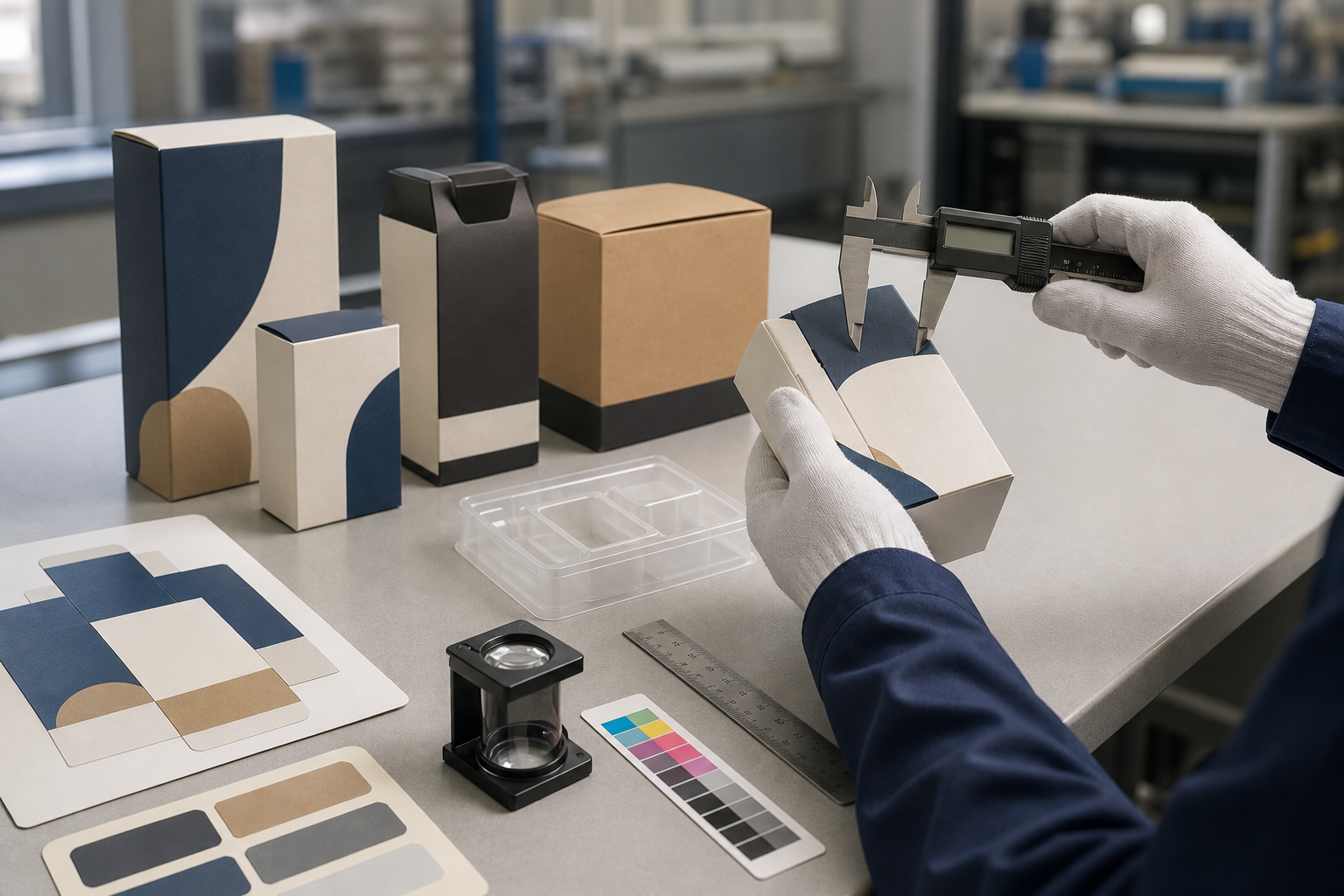
Quality is checked at every stage, not only at the end:
- Raw material procurement and inspection — paper, board and label stock are inspected before they enter production
- First-article inspection — the first piece off the line is verified before mass production runs
- In-process random sampling — samples are pulled during the run, not only after it
- Final inspection to AQL standards — the finished batch is checked against recognised AQL acceptance levels
- Non-conforming isolation — units that fail inspection are isolated and kept out of the shipment
What we check
- Printing: color accuracy and registration across offset, flexo, screen and digital printing
- Surface finishing: lamination, varnishing, hot foil stamping, UV coating and embossing
- Post-press: die-cutting, creasing and scoring; box gluing, window patching and rope threading; label die-cutting and waste removal; thermoforming for plastic trays
- Structure: dimensions and folding performance against the approved sample
Photo documentation
Production is documented with photos, so you can see the batch before it ships rather than finding out after it arrives.
Why this matters for your brand
A packaging defect is visible on the shelf and in unboxing photos. Inspecting material, first article, in-process and finished goods protects your product presentation — and your reorder schedule.
Contact: ying@fly-print.com | WhatsApp +86 13600681558
FAQ
Q1. How do you control the quality of my order?
A. Material is inspected on arrival, the first article is verified before mass production, samples are pulled at random during the run, and the finished batch passes a final inspection to AQL standards. Units that fail are isolated from the shipment.
Q2. What is first-article inspection?
A. It is the check of the first piece produced, before mass production starts, confirming that printing, structure and finishing match the approved sample.
Q3. Do you inspect to AQL standards?
A. Yes. Final inspection is carried out to AQL acceptance standards.
Q4. Will I see photos of my order before shipping?
A. Yes. Production is documented with photos, so you can review the batch before it is dispatched.
Q5. What happens to units that fail inspection?
A. Non-conforming units are isolated and excluded from the shipment, and our team documents what was found and how it was resolved.
Q6. Which printing methods do you use?
A. Offset, flexo, screen and digital printing — selected according to the product type and order size.
What is AQL and which level do you use?
AQL (Acceptable Quality Limit) is a sampling method defined in ISO 2859-1: instead of inspecting everything, a defined number of units is drawn at random and compared against defect limits. We inspect to AQL sampling, and the level applied is agreed in the order specification. AQL is an acceptance rule, not a defect guarantee — it defines what is acceptable, not what is perfect.
Do you provide an inspection report?
Yes. Each stage is recorded with photos — first article, in-process sampling and final inspection — and shared with you before the goods are packed. A useful report states the lot size, sample size, AQL applied, defects found by category, and the pass/fail decision, and it should be traceable to the order number.
Can I use a third-party inspection company?
Yes. Many buyers appoint an independent inspection firm — SGS, Bureau Veritas and TÜV are commonly used — to inspect before shipment. Tell us the schedule early so production can be planned around the inspection window; a third-party inspection added after packing is far less useful.
What happens if goods arrive out of specification?
Notify us with photographs, the quantity affected and the order number as soon as the issue is identified. Claims are far easier to resolve inside the agreed claim window, while the production record and retained samples are still available. The remedy depends on severity — replacement, credit or rework.
How do you keep colour consistent between batches?
By fixing a reference: an approved physical sample plus recorded ink formulation and substrate grade. Colour drift usually comes from changing substrate or ink supplier between runs, so we hold the specification rather than matching to the previous delivery. For brand-critical colour, a spot colour is more stable than a four-colour build.
Are barcodes verified after printing?
Yes, where the artwork includes one. Barcodes are checked for print quality and scanability, with grade depending on the symbology and the customer's requirement. Barcodes are the most common cause of retail chargebacks, so verify the grade requirement before production rather than after.
Related reading: custom printed paper boxes, shipping and production lead time, custom packaging minimum order quantities.
