
 English
 Deutsch
 Italia
 français
 Español
 Português
 русский
 العربية
 日本語

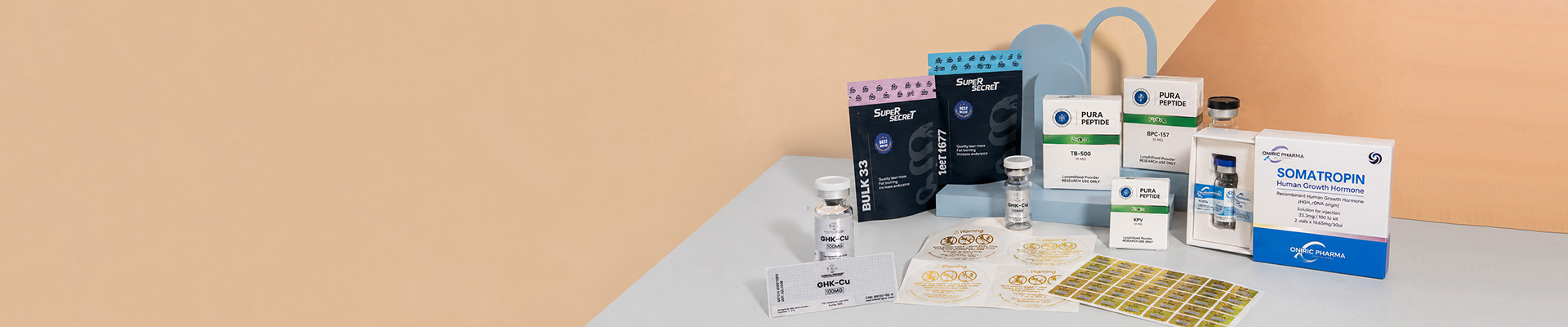

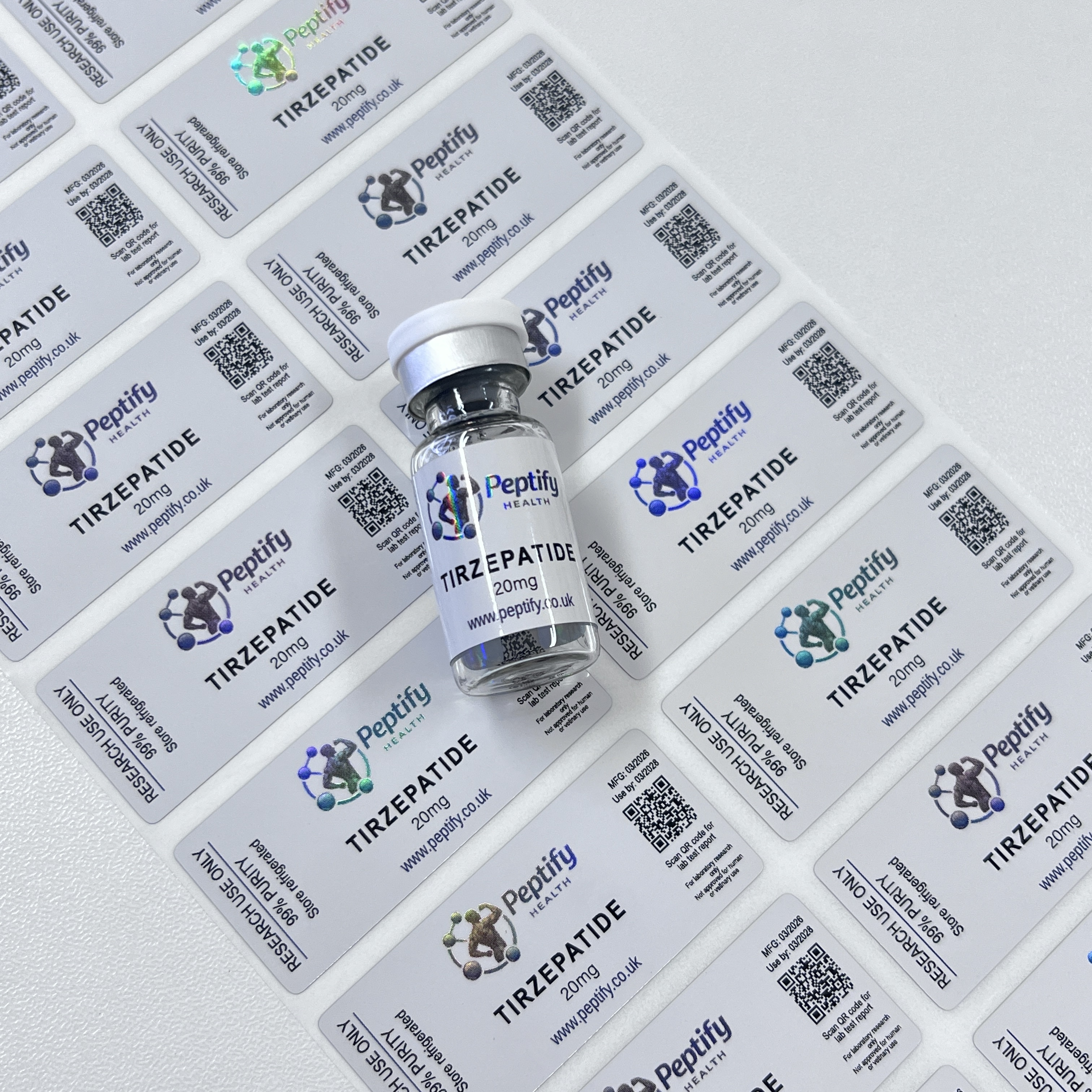
A 3ml vial label is a small-format self-adhesive label applied to the barrel of a 3ml glass or plastic vial, usually for peptides, small-volume injectables and laboratory reference samples. Because the barrel is narrow and the printable area is short, the label is decided by four things before design starts: the exact barrel diameter at the point of application, the height available between the shoulder and the base curve, the adhesive needed for the vial's surface, and whether the label goes on by hand or on an automatic applicator. Everything else - print method, finish, barcode - follows from those four.
What is a 3ml vial label?
It is a pressure-sensitive label, supplied on rolls or sheets, sized to wrap a 3ml vial without overlapping into the neck radius or the base. Most 3ml vials are filled and capped by the customer, so the label is normally applied after filling or on a separate labelling line. That means the label has to survive the fill environment, condensation from cold storage, and repeated handling in a freezer box.
The label is not a decorative element on this format. On a vial it carries the identity of the contents, the batch, the concentration and usually a barcode. If it lifts at the edge or the print scuffs, the vial becomes unidentifiable.
Why 3ml vials are harder to label than a bottle
Three physical constraints drive every decision on this format.
Curvature. A 3ml barrel has a small circumference, so the label bends sharply around it. A stiff face stock will lift along the leading and trailing edges. This is why small-diameter work usually needs a more conformable film rather than a heavy paper stock, and why heavy foil coverage is a poor choice here - foil cracks along a tight curve. Keep foil to a flat panel or a large-radius area.
Limited height. The usable label height is bounded by the shoulder above and the base curve below. That leaves little room for the elements buyers want: product name, strength, volume, batch, expiry, storage condition, barcode. Something has to be prioritised, and that decision is a specification decision, not a design preference.
Surface. Glass, cyclic olefin polymer and plastic vials behave differently. Low-surface-energy plastics such as PP and HDPE need a different adhesive from glass. A general-purpose permanent adhesive that performs perfectly on glass can fail on a plastic vial within weeks.
The five measurements to send with your enquiry
Most vial label quotes go back and forth for days because the enquiry is missing numbers. Send these five and a quote can be built in one pass.
1. Barrel diameter at the exact point where the label sits - not the nominal vial size. A 3ml vial from two suppliers can differ by a millimetre, which changes the wrap length.
2. Available label height, measured from the top of the base curve to the bottom of the shoulder radius. This is the hard ceiling on label height.
3. Gap between the two label ends after application. A small gap looks deliberate; an overlap looks like a mistake and can lift.
4. Vial material - glass, PP, COC or other - and whether the vial will be chilled, frozen or wiped with solvent.
5. Application method - hand or automatic. For automatic application we also need the applicator's core diameter, wind direction and label orientation, because a roll wound the wrong way stops a labelling line.
If you do not have drawings, send one filled vial and we will measure it.
Which face material holds on a 3ml vial
Coated paper is the economical default for dry, indoor, short-life vials. It prints well and takes a writable surface, which laboratory users often want for annotation. It is not water resistant.
White BOPP is the workhorse when the vial will be chilled, handled or wiped. It resists moisture and tearing and conforms reasonably to a small curve.
Clear BOPP gives a no-label look where the vial itself, or the fill, is the visual. It is common on clear glass where the content is the selling point.
Metallised and holographic stocks are used for anti-counterfeiting and premium positioning. On a small diameter, keep holographic or foil areas away from the sharpest part of the curve.
For pharmaceutical and laboratory use, paper with a writable surface is frequently specified so the user can annotate the vial by hand.
Printing: small type, barcodes and variable data
On a 3ml label the smallest type is the constraint that decides the print method. Digital printing handles short runs and variable data - serial numbers, batch codes, QR codes - without plate cost, and short digital runs ship in 48 hours. Flexo and offset become economic once the run is long enough to absorb setup.
Two practical points. First, a barcode needs a quiet zone on both sides; on a narrow label this is often what forces the label height up, so decide the barcode standard before approving the layout. Second, check that the smallest text still reads after the label curves around the barrel - a proof on flat stock does not show this, which is why we recommend a hand-application test on your actual vial.
Roll or sheet?
Rolls suit automatic applicators and any volume where hand application becomes a bottleneck. Sheets suit hand application, small trials and laboratories that label on demand. The choice affects the die and the run setup, so state it in the enquiry rather than after the artwork is approved.
Minimum order, sampling and lead time
Labels start at 1,000 pieces. That figure reflects the setup cost of a roll run, not a material limit - which also means the minimum is already a trial-sized run. Material and adhesive samples take 1-3 working days. Printed proofs on final stock take the same, provided the artwork is print-ready. Bulk label runs take 7-15 working days after approval. Sample cost is credited against the bulk order.
Artwork requirements, bleed and dieline setup are covered in design files and dielines; the order-size logic is explained in how minimum order quantity works.
How we check a vial label run
Four gates, in this order: incoming material and adhesive verification against the specified grade; first-article approval, including a hand-application test on your vial where one is available; in-process sampling for register and die-cut accuracy; and final AQL inspection before packing. We check die-cut alignment, matrix stripping, and that no adhesive bleeds into the print area.
The process is described in more detail in how quality control works.
Frequently asked questions
Can you print a 3ml vial label with a barcode and a batch number?
Yes. Variable data - barcodes, QR codes, batch and serial numbers - is printed digitally, so each roll can carry different data without plate cost.
Will the label survive cold storage and condensation?
With a film stock and the right adhesive, yes. Tell us the storage temperature and whether the vial is wiped with solvent; the combination is specified against that, not guessed.
Can you match a Pantone colour on a small label?
Yes, on both paper and film stocks. Send the Pantone reference and, for critical brand colours, a physical target.
Can I label vials by hand instead of buying an applicator?
Yes - order on sheets. Sheets are cut for hand application, so the label separates cleanly and the backing is easy to peel.
Do you supply the vial as well as the label?
Our scope on this product is the printed label. Vials, stoppers and caps are supplied by your vial manufacturer; we size the label to the vial you already use.
See the 3ml vial label product page for the order route, watch the 3ml vial label production clip, or browse the full self-adhesive label range.
