
 English
 Deutsch
 Italia
 français
 Español
 Português
 русский
 العربية
 日本語
日本語
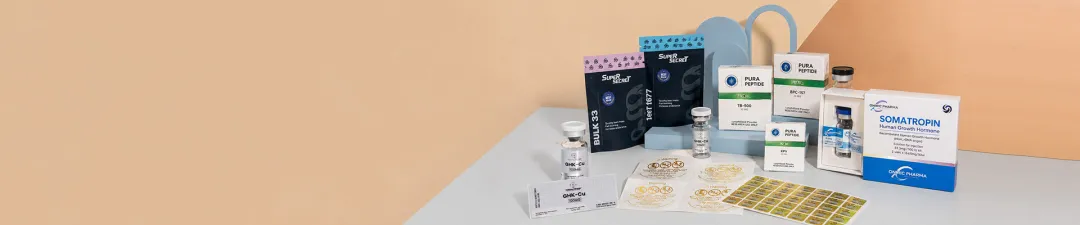

Peptide packaging means the printed outer packaging around a peptide product: the carton, the vial label, the tray that holds the vial, and the seal or tamper strip that closes the box. We print that packaging at our Wenzhou factory from 100 pcs for boxes and trays and 1,000 pcs for labels, with free design and free proofing, quotes in 24 hours, samples in 1–3 business days and bulk in 7–15 business days. If you are a peptide brand, a research-supply reseller or a contract packer who needs the outer packaging only — not the product itself — this is where to start.
What Makes Peptide Packaging Different From Ordinary Cartons
A peptide product is usually small, high-value and bought by someone who knows exactly what they are looking for. That combination drives three requirements that a general carton supplier often misses.
The box has to hold a specific vial or pen. A 3ml vial, a 10ml vial and a pen format have completely different internal geometry. We quote from your actual vial or pen dimensions, not from a catalogue size, and we propose the clearance and the tray rather than leaving you to work it out.
The print has to look controlled rather than promotional. Peptide branding tends to be restrained: a molecule name, a dosage figure, a thin rule, one metallic accent. Over-designed packaging reads as a consumer supplement and can undermine a product that is being bought on specification.
The parcel has to arrive intact. These are low-volume, high-value shipments, often by express to a single address. Boxes therefore need to close firmly, tolerances need to survive handling, and the label needs an adhesive that will not lift if the shipment sits in a depot.
None of that requires us to be anything other than a printer. We are a packaging supplier, not a pharmaceutical manufacturer — we do not produce, fill or sterilise peptides. We make and print the packaging that goes around them.
Cartons, Trays and Storage Boxes for Peptide Vials
The starting point is how many vials go in one box, and how they travel.
A single-vial retail carton is the most common first order. It holds one 3ml or 10ml vial, usually upright in a paper tray so the cap does not touch the lid. This is the format that suits a product sold in ones.
A peptide vials storage box carries several vials at once, with a divider or a multi-cavity thermoformed tray. It is built for handling and shipping rather than for shelf display, and it is the format most resellers choose.
A drawer or book-style box is chosen when the presentation matters — the tray slides out and the vial sits in a shaped bed. It costs more per unit and takes longer to make, so it is normally used for a flagship product rather than for every SKU.
A pen-format carton is a different shape entirely, because a peptide pen is long and cylindrical. Pen cartons are built around the barrel and the cap, and usually include a cradle rather than a tray. See our peptide pen packaging page for the dimensions that change.
Because we produce trays as well as boxes, the vial-to-tray fit is settled in one design step. That is where most peptide packaging goes wrong when a brand buys a box from one supplier and a tray from another: the two are dimensioned independently, and the vial either rattles or will not seat.
Printing, Foil and the Details Buyers Notice
Peptide brands tend to ask for the same short list of finishes, and there is a reason for each.
Hot foil stamping in gold, silver, red gold or laser silver gives a small carton presence. On peptide boxes the foil is usually limited to the logo, the product name or a dosage badge — large foil areas scuff during transport on a small format.
Matte lamination is the most requested finish. It reads as clinical rather than retail, holds a fingerprint-free surface, and protects the print when boxes are packed into a master carton. Gloss lamination is used when the design depends on colour depth rather than restraint.
UV spot coating creates a gloss contrast against a matte background without a second foil pass, which makes it the cheapest way to lift one element — commonly the molecule name.
Embossing raises the logo or a repeat pattern and is read as texture. It is most often used on drawer boxes where the front panel would otherwise be plain.
Holographic and laser silver stock is used where a brand wants an overtly anti-counterfeiting look on the box or the vial label. We print on it; we do not describe any printed element as counterfeit-proof.
Stocks are coated paper, kraft, silver card and synthetic. We will tell you when a chosen stock will not carry a requested finish — a heavy emboss on a thin sheet cracks, and it is far better to hear that during proofing than after the run.
Low MOQ: Starting a Peptide Packaging Range Without Overcommitting
Boxes, cards and trays start at 100 pcs; labels start at 1,000 pcs. For peptide brands this is usually the difference between launching and waiting.
A first order of 100 boxes lets you fill, photograph and ship a real product, see how the vial behaves in the carton, and find out whether your dimensions were right — without a 10,000-piece commitment based on a digital mock-up. Your artwork and die stay on file with us, so a repeat run at a larger quantity changes nothing except the price per unit.
Two things worth knowing before you order. A 100-piece run spreads setup cost over fewer units, so the unit price is higher than at 5,000 — we quote both so the trade-off is visible rather than hidden. And 100 pcs is a production minimum, not a sample quantity: physical samples are a separate and much faster step, at 1–3 business days.
If your range has several SKUs, the usual approach is to prove the packaging on the product that matters most, then extend the same dieline family across the rest once the format is confirmed.
How a Peptide Packaging Order Runs
- Send what you are packing — vial or pen dimensions, how many per box, and the quantity you need.
- Structural drawing and quote within 24 hours, including the tray recommendation and any dimension that needs to change.
- Free design and proofing. Send artwork and we place it on the dieline and return a proof; if you have only a logo, we propose one to three directions, normally within two to three days, and revise until it is right.
- Physical sample in 1–3 business days. You check it against the real vial. This step catches a millimetre error while it is still cheap.
- Bulk production in 7–15 business days after approval, behind four quality gates: incoming material, first article, in-process random sampling, and final AQL inspection with defects isolated rather than shipped.
- Delivery by sea, air or express to any of the seven regions we serve. Payment is T/T with a 30–50% deposit.
FAQ
What is the minimum order for peptide packaging?
Boxes, cards and trays start at 100 pcs; labels start at 1,000 pcs. Samples are separate and take 1–3 business days.
Can you package a peptide pen as well as a vial?
Yes, as a carton — pen packaging is built around the barrel and cap and normally uses a cradle rather than a tray. See our peptide pen packaging page for the specific dimensions.
Do you supply the vials, caps or stoppers?
We print the outer packaging: cartons, trays, labels and cards. We are a packaging supplier, not a pharmaceutical manufacturer and do not produce or fill the product. If you need the bottle and closure supplied as a matched set with the packaging, tell us in the enquiry and we will confirm what we can provide.
Can you copy the packaging of a product I already sell?
We reproduce the print and the structure from your artwork or a physical sample. We do not copy another company’s brand identity, and we will ask you to confirm you hold the rights to any artwork supplied.
How do I know the vial will fit before I commit to a run?
That is what the physical sample is for. Send the vial’s outer diameter and height with the cap on; we return a drawing within 24 hours and a sample within 1–3 business days, and you check the fit before bulk production starts.
What do you need to give me a quote?
The product being packed, its dimensions, how many units per box, the quantity, and the destination region. Artwork is useful but not required to price the job.
Do you offer anti-counterfeiting features?
We print on holographic and laser silver stock and can add foil elements. Any decision about how much protection you need is a brand decision; we print to your specification and do not certify a label as counterfeit-proof.
Start a peptide packaging project — send your vial or pen dimensions and target quantity, and you will have a structural drawing and a price within 24 hours. Free design and proofing; boxes and trays from 100 pcs; samples in 1–3 business days.
