
 English
 Deutsch
 Italia
 français
 Español
 Português
 русский
 العربية
 日本語



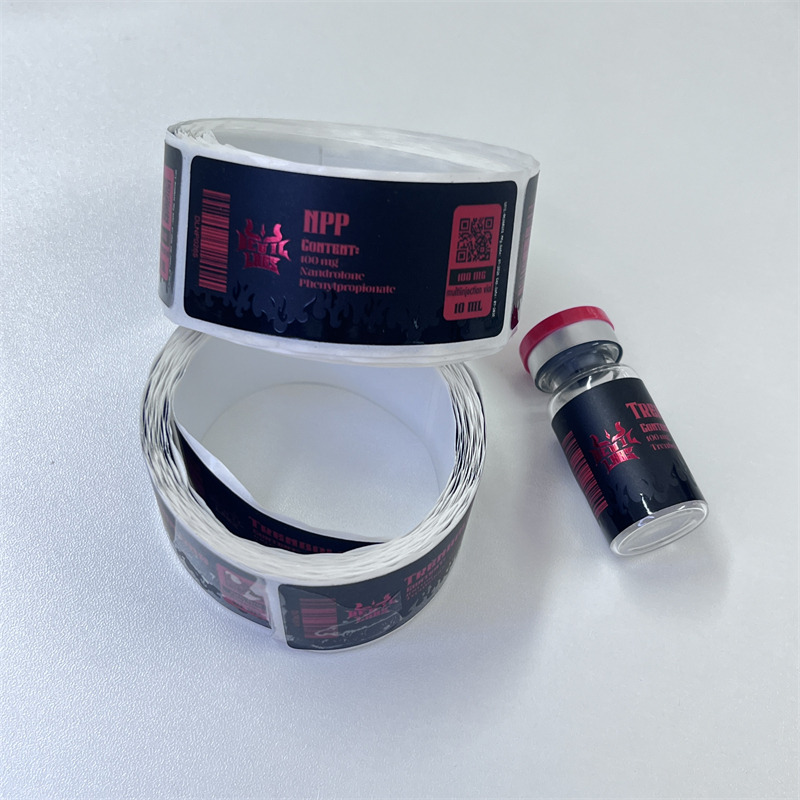
Roll or sheet is not a printing preference, it is an application decision. If the labels go on by hand, sheets are usually the practical answer at low volume. If they go on through an applicator, rolls are the only format that runs. The cost per label also moves with the format, but the break-even sits lower than most buyers expect: a roll-fed order at a few thousand pieces is normally cheaper per unit than the same job on sheets.
What actually changes between the two
The die. A roll label is die-cut on a web, against a liner, in line with the press. A sheet label is cut to a sheet, either as a full sheet that you cut yourself or as a pre-die-cut sheet with the shapes already in place. The die is the same shape either way; the difference is whether it cuts into a roll or into a sheet.
The application. A roll needs a dispenser or an applicator to peel the label off the liner. A sheet can be peeled by hand. On a small vial this matters: placing a curved label straight by hand is slow, and a hand-applied run of a thousand vials is a real cost in labour.
The waste. A sheet carries the margin around each label as part of the sheet. A roll carries the gap between labels plus the liner. At small volumes the sheet waste is easier to absorb; at large volumes the roll wins on material use.
When sheets are the right answer
- Runs from 100 to about 1,000 pieces, applied by hand
- Small vials or irregular shapes where a jig is not worth building
- Several different designs on one order, where each design is a short run
- A test market, a sample batch, or a trade show quantity
- A customer who prints variable data in-house on a laser or inkjet sheet
When rolls are the right answer
- Any run applied on an automatic or semi-automatic applicator
- Label counts where hand application would cost more than the labels
- Long runs of a single size and design
- Small-diameter vials where a machine places the label more accurately than a hand can
- Any job that has to run continuously without reloading a sheet
The specification that has to be settled before a roll order
A roll is not a generic object. A press needs four numbers before it can wind a roll that fits your applicator.
- Core diameter. 76 mm is the common industrial core; smaller cores exist for desktop applicators. Give the core your machine accepts.
- Wind direction. Which edge of the label leads as the roll unwinds. Get this wrong and the labels come off upside down.
- Label gap and repeat. The distance from one label to the next, which the applicator uses to register each label.
- Maximum roll diameter. Set by the unwind station on your machine, not by the press.
If you do not have those numbers, send the applicator model, or a photo of the unwind station with a ruler against it. It is faster than guessing and it avoids a rewind.
Cost: where the break-even actually sits
Two things drive the difference. Sheets carry a fixed amount of surrounding margin, so a sheet job has a cost floor that does not fall much with quantity. Rolls carry a die and a make-ready, so the first roll costs more but the per-label price falls faster as the count rises.
In practice, a job of a few hundred pieces is usually cheaper on sheets once the die and make-ready are counted, and a job in the low thousands is usually cheaper on rolls if an applicator already exists. The exact crossover depends on label size, material and how many colours are printed, so it is worth asking for both formats quoted on the same specification rather than assuming one is cheaper.
What to send for an accurate quote
- Label size, or the vial diameter and the height you want to cover
- Roll or sheet, and if roll, the four numbers above, or the applicator model
- Material and finish, and whether the vial is stored cold
- Quantity, number of designs, and whether variable data is printed
- The artwork, or a note that artwork is still to come
How we produce it
Labels are printed and die-cut to your size, then wound on the core and in the wind direction your applicator needs, or cut into sheets for hand application. A physical proof is produced before the run so the stock, the finish and the die are confirmed on the actual material.
Minimum order is 100 pieces per size and design. Proofing takes 1 to 3 business days from approved artwork, bulk runs 7 to 15 business days after approval, and digital short runs ship in 48 hours.
Frequently asked questions
Can I order rolls if I apply the labels by hand?
Yes, but you will need a dispenser. A roll without a dispenser is slower to apply by hand than a sheet, because the liner has to be peeled away while the label is held square.
What core size should I ask for?
Whatever your applicator accepts. 76 mm is the common industrial core; desktop machines often take a smaller one. The safe answer is to quote the machine model.
Is a roll more expensive at low volume?
Usually yes, because the die and make-ready are spread over few labels. At a few hundred pieces a sheet order is normally cheaper; at a few thousand the roll usually wins.
Can one order mix rolls and sheets?
Yes, as separate line items. They are different finishing runs, so they are quoted separately even when the artwork is the same.
Related: vial labels and peptide labels, zipper bags and pouches, design files and dielines, how minimum order quantity works.
