
 English
 Deutsch
 Italia
 français
 Español
 Português
 русский
 العربية
 日本語
日本語
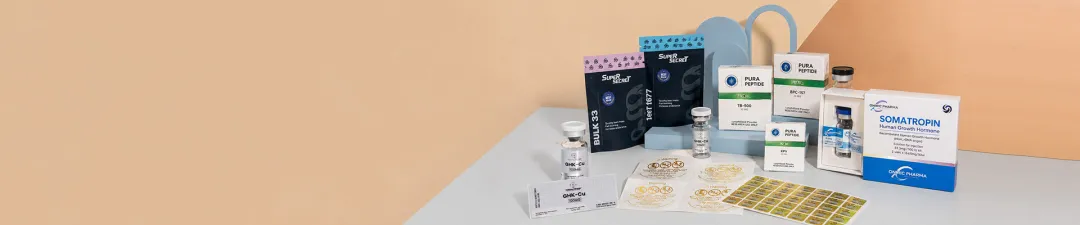

A vial label is the pressure-sensitive label wrapped around a glass vial or crimp-top bottle, and on a 3ml vial it is usually the only surface carrying the product name, the volume and the batch line. We print vial labels on roll or sheet from 1,000 pcs, die-cut to your finished shape, with free design and free proofing, at our Wenzhou factory. Quotes come back within 24 hours, samples in 1–3 business days, and bulk in 7–15 business days. If you need the label matched to a vial box, a tray or a cap, all of it can be produced and proofed together.
What Changes When the Label Goes on a Vial
Small-diameter labelling is a different problem from labelling a flat carton, and most first-time problems on a 3ml vial come from the curve rather than from the print.
A 3ml vial is narrow enough that its curvature eats a measurable slice of the label’s leading edge. Artwork that reads perfectly flat will lose its first few millimetres as the label wraps away from the reader’s eye. Practical fixes are simple: keep text away from the leading edge, avoid thin rules that run vertically, and place the volume or the molecule name where the radius is flattest.
The second issue is the seam. On a fully wrapped label the two ends meet, and any registration drift shows up as a visible join. We set the gap deliberately rather than trying to hide it, and we ask for the placement height so the seam falls where your designer intended rather than where the roll happens to stop.
The third is adhesive behaviour on cold or slightly damp glass. If your vials are chilled before labelling, the adhesive needs to be chosen for that, not for room temperature. Tell us the storage and handling conditions and we will specify accordingly — it is not something you can fix after the labels are printed.
Materials and Adhesives for 3ml Vial Labels
Four stock families cover nearly everything we print for vials.
Coated paper is the default. It takes fine type well, prints cleanly at small sizes, and is the most economical choice for a first run. It needs a laminate if the vial will be handled with wet hands or stored in a humid room.
Synthetic paper and PE are the choice when the label has to survive moisture, oil or a wipe-down. Milky white PE gives an opaque, slightly soft look; clear synthetic gives the “no-label” look that cosmetic and supplement brands often want on a small vial.
Transparent stock is printed in reverse and applied over a printed or coloured surface, so the glass and any under-print show through. On 3ml vials this is usually paired with a minimal design, because fine white text on clear film is unforgiving to register.
Foil and holographic stock — including laser silver and holographic film — is used where the brand wants an anti-counterfeiting signal or a strong shelf presence. We print on these stocks and can also add hot foil stamping or a scratch-off panel on paper labels.
Finish options are gloss or matte varnish, gloss or matte lamination, spot UV and hot foil stamping. On a small vial label we usually recommend restraint: one contrast, one foil element at most. A label that carries too many finishes at 20 mm wide tends to read as noise.
Do You Also Print the Vial Box and the Tray?
Yes — and doing all three in one place removes the most common source of mismatch on a vial project.
A vial presentation is a set: the carton, the tray that holds the vial, and the label. If the label is printed by one supplier and the box by another, small differences in colour and finish become obvious the moment the parts sit next to each other on a table. Because we produce boxes, trays, cards and labels from the same plant, one proofing round covers the whole set, and the colour you approve on the label is the colour we match on the box.
It also changes the timing. Coordinating three suppliers usually means three lead times stacked in sequence. Here the box and the label run to the same schedule, so a 3ml vial project with a box, a tray and a label still finishes inside the 7–15 business day window after sample approval.
If you already have a box supplier you are happy with, we can print only the labels — you do not need to move the whole job to work with us.
Quantities, Artwork and How the First Order Runs
Labels start at 1,000 pcs, and boxes and trays start at 100 pcs. That difference is practical rather than arbitrary: label printing and die-cutting are set up on a roll, so a 1,000-piece first run is what makes the setup worthwhile, while a box can be produced economically at 100.
For a first order, the usual sequence is:
- Send the vial’s outer diameter and the label’s height, plus the quantity.
- We return a dieline and a quote within 24 hours, including the adhesive recommendation for your handling conditions.
- Free design. Send artwork and we place it on the dieline and return a proof. Have only a logo? We propose one to three label layouts, normally within two to three days, and revise them until it is right.
- A physical sample in 1–3 business days, applied to a vial where possible, so you can see the wrap and the seam rather than imagine them.
- Bulk production in 7–15 business days after approval, with four quality gates: incoming material, first article, in-process random sampling and final AQL inspection with defects isolated.
- Shipping by sea, air or express to the regions we serve. Payment by T/T with a 30–50% deposit.
Send a PDF, AI or CDR file and we will tell you within a day whether it is print-ready — most artwork problems at vial scale are fixable before the plate is made, and much harder to fix afterwards.
FAQ
What is the minimum order quantity for vial labels?
1,000 pcs. Vial boxes and trays start at 100 pcs, so a box-plus-label project can begin with a box run of 100 and a label run of 1,000.
Can you match the label to my vial box?
Yes. Boxes, trays, cards and labels are produced here, so one proof approval covers the set and the colour is matched across all of them.
What is the difference between a vial label and a 3ml vial label?
Only the size. The construction, stocks and adhesives are the same; a 3ml vial label is simply cut to the smaller diameter, where the wrap and the seam need more attention in the artwork.
Which stock should I choose for a peptide or supplement vial?
If the vial is stored cool or handled regularly, start with synthetic paper or milky white PE rather than uncoated paper. Tell us the storage conditions and we will confirm the adhesive as well as the face stock.
Can the label include an anti-counterfeiting element?
We print on holographic and laser silver stock and can add hot foil stamping or a scratch-off panel. Which of these is appropriate is a brand decision; we print what you specify and will not describe a label as counterfeit-proof.
How fast can I see a proof?
Quote and dieline within 24 hours, design proposals in about two to three days, physical sample in 1–3 business days.
Do you print the vials themselves?
No. We are a packaging supplier, not a pharmaceutical manufacturer. We print labels, boxes, trays and cards — the outer packaging around the vial. Where the bottle and closure need to be supplied as a matched set with the packaging, say so in the enquiry and we will confirm what we can provide.
Start a vial label project — send the vial diameter, label height and quantity, and you will have a dieline, an adhesive recommendation and a price within 24 hours. Free design and proofing; labels from 1,000 pcs; samples in 1–3 business days.
